GPS Tracker for a Parent With Dementia: What Works
Six in 10 people with dementia will wander. Here's what actually keeps them safe: honest comparison of GPS watches, AirTag, shoe insoles, and MedicAlert.
On this page 10 sections
- Why AirTag fails for dementia wandering
- Real-time cellular GPS: the current standard
- MedicAlert + Alzheimer’s Association Safe Return
- Geofencing: the alert layer
- What to do the moment someone wanders
- Capacity, consent, and the least-restrictive principle
- Building a layered system
- Talking to siblings and care facilities
- Checking insurance coverage
- The bottom line
Six in 10 people living with dementia will wander at least once, according to the Alzheimer’s Association. Many will wander repeatedly. A person found within 15 minutes usually comes home safely. A person not found within 24 hours faces a very different outcome. That gap, 15 minutes to 24 hours, is exactly what a GPS tracker is designed to close.
The problem is that not every device marketed as a “GPS tracker for dementia patients” actually delivers real-time location. Some are Bluetooth tags that depend on other people’s phones nearby. Some are cellular devices with month-long battery life. Some are insoles sewn into shoes. Each has a failure mode your parent’s situation may expose.
This guide matches device type to failure mode, names real products and real prices, and tells you what to do the moment someone wanders.
A note on dignity and consent. Tracking any adult, including a parent with dementia, is a serious decision. Where your parent still has capacity to participate in the conversation, include them. Explain what the device does, where the data goes, and who can see it. Many people in early dementia can agree to a GPS watch the same way they agree to a medical alert bracelet: they understand it is a safety tool. When capacity is absent, the tracking decision typically falls to a legal guardian, healthcare proxy, or person holding medical power of attorney. Best practice is the least restrictive option that achieves safety. A GPS watch that allows the person to move freely is less restrictive than a locked door.
Key Takeaways
- AirTag is not a dementia tracker. It has no real-time GPS and can go hours without updating location, especially in rural areas.
- Cellular GPS watches and pendants (roughly $25-$60 device + $15-$40/month) are the current standard for real-time wandering response.
- GPS shoe insoles are the hardest to remove for someone who resists wearing devices.
- If your parent is not found in 15 minutes, call 911 and inform them the person has dementia.
- Enroll your parent in MedicAlert + Alzheimer’s Association Safe Return ($49-$99/year) as a backup layer regardless of what GPS device you choose.
Why AirTag fails for dementia wandering
AirTag does not have GPS inside it. It has a Bluetooth chip that broadcasts an anonymous signal to nearby iPhones, which then relay the tag’s location back to Apple’s Find My network. As I explain in detail in the guide to AirTag for tracking people, this means location only updates when an iPhone physically passes within Bluetooth range, about 30 to 100 feet.
In a city with dense iPhone traffic, an AirTag might update every few minutes. In a suburb at 2 a.m., it might not update for hours. In a rural area, it might not update at all. A person with dementia who wanders into a park at night, or boards a rural bus, becomes invisible to the system exactly when the stakes are highest.
A second problem is wearability. AirTag is a 32-millimeter disk. It can be sewn into clothing, slipped into a shoe, or attached to a keyring on a belt loop, but there is no form factor designed for a confused older adult who may remove or discard it. AirTag works as a secondary layer, not a primary one.
Real-time cellular GPS: the current standard
A cellular GPS tracker pushes location to your phone continuously, without depending on nearby strangers’ devices. The device uses GPS satellites to find its position and a cellular network (typically LTE-M or NB-IoT, low-power variants designed for IoT devices) to transmit that position to a cloud server, where you can see it on a map in your phone’s app.
Battery life is the tradeoff. Real-time GPS burns power. Most cellular GPS watches and pendants last 1 to 5 days on a charge, compared to a year for AirTag. That means you or your parent needs to charge the device daily or every few days.
For someone with moderate-to-severe dementia, daily charging is a caregiver task, not a patient task. Factor that in.
GPS watches
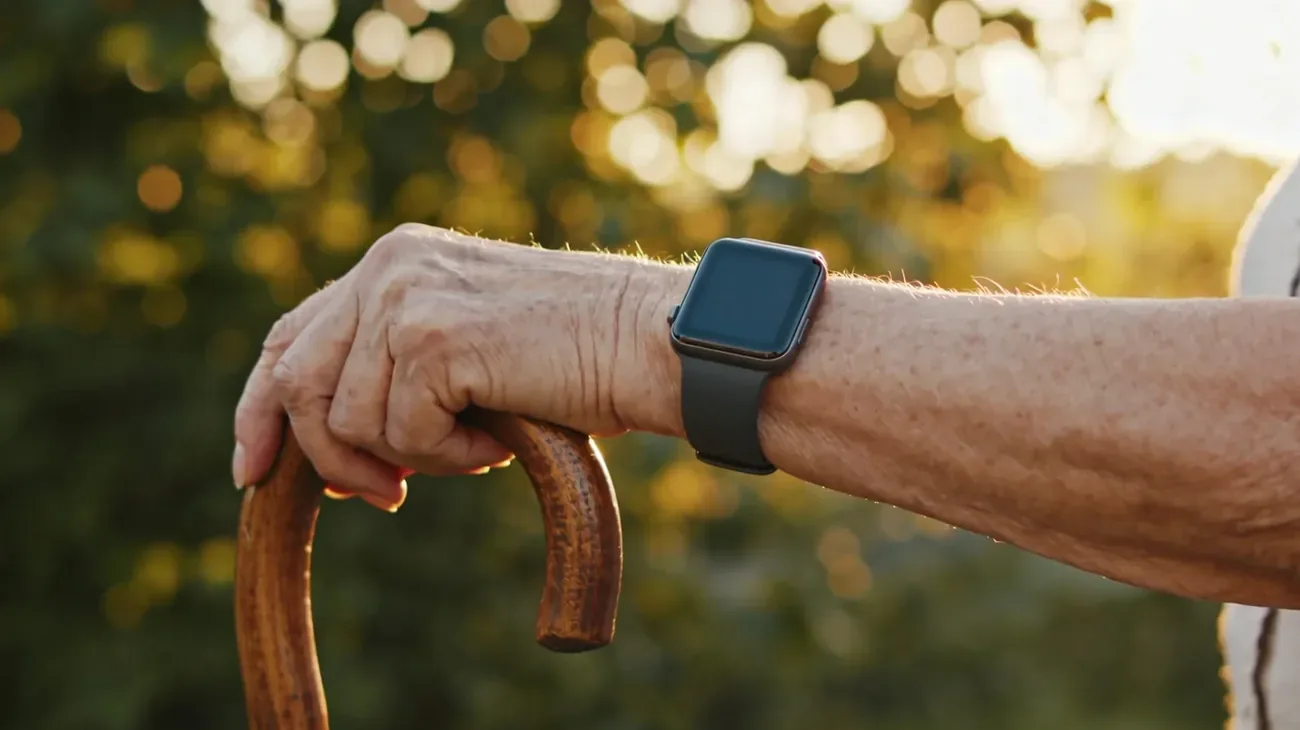
Wrist-worn GPS watches are the most common form factor for dementia tracking. Most include a cellular connection, two-way calling so your parent can reach you with a button press, fall detection, and geofencing (you get an alert the moment they step outside a defined area like the yard or the care facility).
Prices vary by feature set:
| Device type | Real-time GPS? | Battery | Wearability for removal-prone users | Typical monthly cost |
|---|---|---|---|---|
| Apple AirTag (Bluetooth only) | No (crowdsourced) | ~12 months | Low (easy to remove/discard) | $0 |
| GPS watch (LTE) | Yes | 1-3 days | Medium (wristband, some remove it) | $15-$30 |
| GPS pendant (LTE) | Yes | 2-5 days | Low-medium (easy to pull off) | $15-$30 |
| GPS shoe insole | Yes | 2-4 days | High (most don’t think to remove shoes) | $25-$40 |
| GPS belt clip / hidden pouch | Yes | 2-5 days | Medium (hidden, but removed with clothes) | $15-$30 |
| MedicAlert + Safe Return (ID only) | No (ID + human network) | N/A | High (bracelet) | ~$4-$8/month |
Dedicated dementia GPS watches include options from companies such as AngelSense, Bay Alarm Medical, and Americaloc. Most require a subscription. The subscription pays for the cellular data that carries location updates to your phone.
Before buying, ask the vendor: How often does the device update location? (Every 30 seconds is standard; every 5 minutes is too slow for wandering response.) What happens if the person leaves cellular coverage? Does the device store a track log and send it when coverage resumes?
GPS shoe insoles
GPS insoles (GPS SmartSole, Theora Care) are the only wearable form factor that sits inside a shoe, where most people with dementia do not think to look. The insole contains a GPS chip, cellular radio, and rechargeable battery. You charge them by removing the insoles at night and placing them on a charging pad, or by charging the shoes on a dedicated dock.
Battery life is typically 2 to 4 days per charge. The person’s regular shoes must be large enough to accommodate the insole: most run in US men’s size 8 and above, with some models available for smaller sizes. The insole itself is thin but adds a few millimeters of height.
For a parent who regularly removes a watch, refuses a pendant, or strips clothing, insoles can be the difference between a tracked wandering event and a missing person report. Understanding how GPS positioning actually works helps explain why outdoor coverage is generally reliable while indoor coverage near exits may lag slightly.
MedicAlert + Alzheimer’s Association Safe Return
MedicAlert + Alzheimer’s Association Safe Return is not a GPS device. It is a national identification and response network. Your parent wears a bracelet or necklace engraved with a unique membership number and an 800 number. When a first responder or concerned citizen finds your parent, they call that number. A staffed response center, available 24/7, connects the caller to your family.
Enrollment runs approximately $49 to $99 per year depending on the membership tier. It does not replace a GPS tracker, but it works when every technology layer has failed: when the battery died, when the device was removed, when cellular coverage was absent. A first responder who finds an older adult who cannot give their name will look for a bracelet. Enroll your parent in Safe Return regardless of what GPS device you choose.
To enroll, visit the Alzheimer’s Association website or call their 24/7 helpline at 1-800-272-3900.
Geofencing: the alert layer
Most cellular GPS watches and dedicated dementia trackers include geofencing. You draw a virtual boundary, typically the home address, a care facility perimeter, or a safe walking area, and the device sends you an alert the moment your parent steps outside it. Geofencing is faster than polling. You do not have to check an app; the app calls you.
Set the geofence tight enough to be useful but loose enough to avoid constant false alarms. A 50-meter radius around the front door will trigger if your parent walks to the mailbox. A 200-meter radius may miss a wandering exit long enough that they are already out of the yard before you react. Most caregivers settle on 100 to 150 meters for a house with a yard.
A note on battery: geofencing requires the device to check GPS frequently. Frequent GPS checks drain the battery faster. Some devices let you set geofence-check frequency separately from standard tracking frequency to balance battery life against alert speed.
What to do the moment someone wanders
The Alzheimer’s Association recommends this sequence.
Fifteen minutes, search yourself. Check inside the home first (basements, closets, garages). Outside, consider the dominant hand: wandering patterns typically follow the direction a person writes with. A right-handed person tends to turn right; search that direction first. Check the street, any familiar places (a former workplace, a grocery store, a church).
Fifteen minutes, no sign, call 911. Tell the dispatcher: the person’s name, age, physical description, what they were last wearing, direction they may have gone, and that they have dementia. This is not overreacting. First responders can mobilize search resources within minutes that no family can replicate alone.
Simultaneously: Call the Alzheimer’s Association 24/7 helpline at 1-800-272-3900. If your parent is enrolled in MedicAlert + Safe Return, call that response line as well.
Silver Alert. This is a public notification system, similar to Amber Alert, used in most US states for missing seniors with cognitive impairment. Law enforcement activates it, not the family. Filing a 911 missing persons report is the prerequisite. Criteria vary by state: some require the person to be confirmed missing from a vehicle, some require a minimum time elapsed. Ask the 911 dispatcher whether your parent qualifies in your state.
Capacity, consent, and the least-restrictive principle
The standard in US elder law and care ethics is the least restrictive option that achieves safety. A GPS watch that allows freedom of movement is less restrictive than a locked door. A door alarm that wakes a caregiver is less restrictive than a bed restraint. GPS tracking sits on the permissive end of the spectrum when compared to physical restraints or permanent institutional placement.
That said, legal permissiveness does not answer the ethical question for your specific parent. Tracking a person who is frightened by surveillance, who would feel humiliated by a monitoring device, or who has expressed strong wishes against it in an advance directive requires careful consideration, ideally with an elder care specialist or social worker.
Where your parent still has capacity to participate, involve them. Many people in early-to-moderate dementia can understand the purpose of a GPS watch (“It helps us find you quickly if you get lost”) and accept it the same way they might accept a medical alert bracelet. Framing matters: “We got you this in case you ever get lost” lands differently than “We’re tracking you.” Both are true, but one respects the person’s perspective.
If your parent has a court-appointed guardian or you hold durable medical power of attorney for healthcare, you have legal authority to make this decision on their behalf. Consult an elder law attorney if you are uncertain about your authority in your state.
Building a layered system
No single device is sufficient. The most reliable setups use three layers.
Layer 1: Geofencing GPS watch or insole (primary). Real-time cellular GPS, geofence alert to caregiver’s phone, two-way calling if the person can still use it.
Layer 2: AirTag or similar Bluetooth tag (secondary). Sewn into a coat lining, tucked into a shoe lining behind the GPS insole, or attached to a bag. Useful if the primary device fails or is removed. As explained in the AirTag for tracking people guide, this only works where iPhone density is adequate.
Layer 3: MedicAlert + Safe Return bracelet (backup). Requires no power, no app, no cellular coverage. Works when everything else has failed because a first responder is trained to look for it.
Layer 4: Home environment modifications. The Alzheimer’s Association recommends door alarms that chime when opened, pressure-sensitive mats at the bed and doors, and physical barriers like painted black thresholds at exits, which some people with dementia perceive as a barrier they are unwilling to cross. These are not GPS solutions, but they buy time for GPS to activate.
Talking to siblings and care facilities
Coordinate with everyone who has regular contact with your parent. If your parent lives in a memory care facility, most facilities have their own wandering protocols (door sensors, RFID wristbands, secured exits). A personal GPS device supplements, rather than replaces, those protocols. Ask the facility director what their wandering response procedure is, how quickly they would contact you, and whether personal GPS devices are permitted.
If you are managing care across a family, clarify who has app access to the GPS device and who is the primary contact for alerts. Alert fatigue, where caregivers stop responding because they receive too many false alarms, is a real problem. Set geofence boundaries carefully and designate one primary responder per shift.
Checking insurance coverage
Some Medicare Advantage plans and Medicaid waiver programs cover GPS wandering devices as durable medical equipment or as a covered benefit under home-and-community-based services. Coverage varies by plan and by state. Call the number on your parent’s insurance card and ask specifically about “wandering prevention devices” or “GPS monitoring for dementia.” Bring documentation of the dementia diagnosis.
A few state Medicaid waiver programs (California’s Multipurpose Senior Services Program, for example) cover assistive technology for in-home safety including GPS trackers. An elder law attorney or your local Area Agency on Aging can tell you what is available in your state.
The bottom line
A cellular GPS watch or GPS shoe insole, paired with a MedicAlert bracelet and geofencing alerts to your phone, gives you the fastest possible response to a wandering event. AirTag is not a dementia tracking device on its own. The goal is not surveillance; it is the 15-minute window between your parent leaving and you knowing exactly where to go.
Start with the device your parent will tolerate wearing consistently. The most accurate GPS in the world is useless if it sits in a drawer because your parent refused it after the first week.
Questions & answers
Things readers ask about this
7 questions · updated Jun 2026